Click Winks

Showing posts with label Audi Cars. Show all posts

Wednesday, March 2, 2011

2011 Audi Sports Car R8 GT

INGOLSTADT, Germany, May 1, 2010 Audi presents a limited-production version of it R8 high-performance sports car, the R8 GT, even more powerful, lighter and faster. The output of its 5.2-liter V10 has been increased to 412 kW (560 hp); vehicle weight has been reduced by roughly 100 kilograms (220.46 lb). The R8 GT accelerates from zero to 100 km/h (62.14 mph) in 3.6 seconds and reaches a top speed of 320 km/h (198.84 mph).
The R8 high-performance sports car has been a winner from the very beginning. This applies to both the production models, winners of the “World Performance Car” Award in 2008 (R8) and in 2010 (R8 V10), and to the race car, the R8 LMS, which won 23 races in its first season and claimed three championships. The genes of the race version are now coming to the street – in the R8 GT. The exclusive series is limited to 333 units. Each R8 GT has a badge with its production number on the shift lever knob.
The extremely high strength of the body is the basis for the high-performance sports car’s precise handling, and it also offers good vibration comfort and first-rate crash safety.
The engineers also fought to shave every possible gram of weight from the technical components of R8. They shaved one kilogram (2.20 lb) from the power brake system, four kilograms (8.82 lb) from the aluminum caps of the brake discs and 9.4 kilograms (20.72 lb) from the battery. The engineers also found 2.3 kilograms (5.07 lb) in the air intake module and 2.8 kilograms (6.17 lb) in the insulation of the engine compartment.
The modified V10, whose cylinder head covers are painted red, gives the Audi R8 GT breathtaking performance. The R8 GT sprints from a standing start to highway speed in 3.6 seconds, and from zero to 200 km/h (124.27 mph) in 10.8 seconds. And the thrust does not let up until the top speed of 320 km/h (198.84 mph) is reached.
Changes to the engine electronics coaxed an additional 26 kW from the ten-cylinder, which now produces 412 kW (560 hp) from a displacement of 5,204 cc. The torque curve peaks at 540 Nm (398.28 lb-ft) at 6,500 rpm, 10 Nm (7.38 lb-ft) more than in the production version. The V10 has a specific power output of 79.2 kW (107.6 hp) per liter displacement. Its power-to-weight ratio is 3.70 kilograms (8.16 lb) per kW or 2.72 kilograms (6.00 lb) per hp. The engine redlines at 8,700 rpm.
The normally aspirated engine consumes an average of 13.7 liters of fuel per 100 km (17.17 US mpg) – very good fuel economy given the tremendous power. The FSI gasoline direct injection system injects the fuel into the combustion chambers at up to 120 bar of pressure. The turbulent mixture cools the cylinder walls, enabling a compression ratio of 12.5:1. A variable intake manifold and the continuous adjustment of the chain-driven camshafts ensure that the combustion chambers are fully filled. Flaps in the intake ports facilitate the formation of the mixture by inducing a tumbling motion in the inflowing air.

The 19-inch forged wheels are 8.5 J x 19 up front and 11 J x 19 at the rear, and are shod with size 235/35 and 295/30 tires, respectively. Audi will mount 305/30 tires together with optional wheels on the rear axle upon request. Cup tires, which offer the ultimate in performance on dry roads, are available for racing enthusiasts. At Audi, reducing weight means increasing performance and efficiency, but not sacrifice. The 2011 Audi R8 GT, which Audi sells in Germany for €193,000, comes with an automatic climate control system and power windows, a navigation system with MMI operating logic and a powerful sound system.

Sunday, January 30, 2011

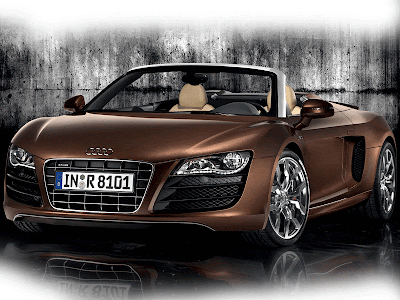
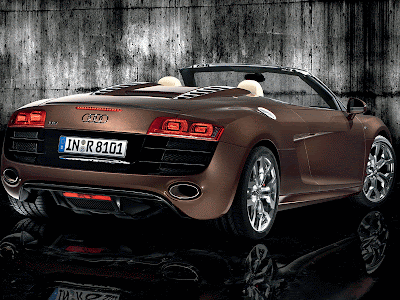
Audi R8 Spyder 5.2 FSI Quattro V10 Engine

Audi R8 Spyder 5.2 FSI Quattro V10 Engine

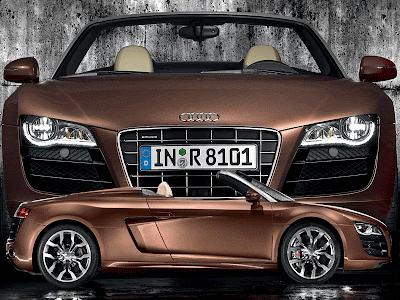
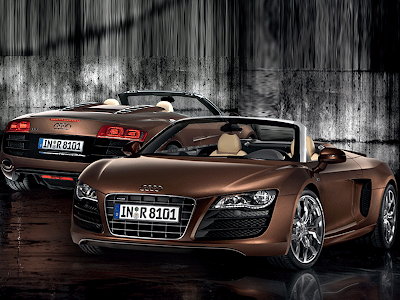
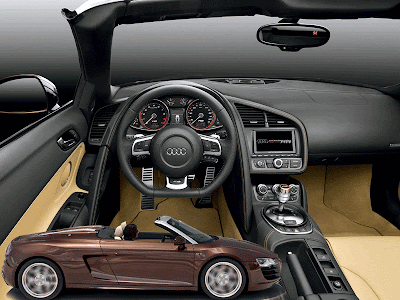
While everybody and their brother likes the R8, there is a small, but vocal minority that's always thought coupe looked a little funny. Well, that group of naysayers can now put a sock in it, as the R8 Spyder is simply gorgeous. Gone are the carbon fiber side blades, in are sensible but somehow better looking slab sides. Regardless, it's simply hot. Exceptional performance and breathtaking dynamism coupled with the intense sensations of open-top driving: Audi presents the R8 Spyder 5.2 FSI quattro. Its lightweight cloth top opens and closes fully automatically; several body parts are made of a carbon fiber composite material.


Audi R8 Spyder 5.2 FSI Quattro V10 Engine

The V10 engine produces 386 kW (525 hp) and launches the open-top two-seater to 100 km/h (62.14 mph) in 4.1 seconds; 0 – 200 km/h (124.27 mph) in 12.7 seconds; on its way to a top speed of 313 km/h (194.49 mph) with the six-speed manual transmission. The 5.2-liter engine features FSI direct fuel injection. Equipped with a manual transmission, the R8 Spyder 5.2 FSI quattro consumes an average of 14.9 liters of fuel per 100 km (15.79 US mpg) – a good figure given its power. With R tronic, this figure improves to 13.9 liters (16.92 US mpg). Featuring technologies such as the Audi Space Frame (ASF), quattro permanent all-wheel drive, full-LED headlights and with an innovative seatbelt microphone available as an option, the R8 Spyder 5.2 FSI quattro is the new top-of-the-range Audi.


Audi R8 Spyder 5.2 FSI Quattro V10 Engine

Unlike the Coupé, the Spyder does not have sideblades behind the doors. The side panels and the large cover over the storage compartment for the cloth top are made of a carbon fiber composite. Two arched cowls, which extend to the spoiler lip and include large, integrated air vents, give the rear of the open-top two-seater a powerful profile.


Audi R8 Spyder 5.2 FSI Quattro V10 Engine

The electrohydraulic soft top opens and closes in 19 seconds, even while driving at speeds up to 50 km/h (31.07 mph). When opened, it folds like a Z into its storage compartment over the V10 engine. The compartment cover opens and closes automatically. The heated glass window, which is separate from the cloth top, is lowered into the bulkhead. It can be independently raised and lowered at the press of a switch, with the top up or down. Audi offers the R8 Spyder 5.2 FSI quattro with a choice of three colors for the top. The body is available in eleven paint finishes, with metallic and pearl effect finishes standard. The windshield frame is coated with anodized aluminum. The leather for the seats are colored with pigments that reflect the infrared component of sunlight, which keeps the seats up to 20 degrees Celsius (68 degrees Fahrenheit) cooler.


Audi R8 Spyder 5.2 FSI Quattro V10 Engine

A worldwide first is the optional seatbelt microphone for the hands-free unit, which makes it possible to talk on the phone even with the top down on the highway. Three small, flat microphones are integrated into both seatbelts. At least one of them is ideally positioned relative to the speaker when the belt is on. There is a fourth microphone in the windshield frame.


Audi R8 Spyder 5.2 FSI Quattro V10 Engine


Audi R8 Spyder 5.2 FSI Quattro V10 Engine

The quattro permanent all-wheel drive features a central viscous coupling and distributes power to all four wheels with a heavy rear bias. It works together with the locking differential on the rear axle to provide significantly greater traction, stability, cornering speed and precision. It is the superior technology – in particular for a high-performance sports car.

Thursday, November 18, 2010

Audi A9 Concept 2010

Audi A9 Concept
Audi A9 Concept


Audi A9 Concept Design by Daniel Garcia

This is the Audi A9 Concept sedan study, a look at BMW's Vision concept through Audi's eyes (unofficially of course) that was created by independent designer Daniel Garcia from Spain.


Just as BMW tried to invent a new market with its 5-Series GT, the Audi A9 Concept would aim to be in a league of its own: over-styled (in a good way) über-luxury hybrid sports saloons. A technologically-advanced Panamera killer.


Garcia says some of the lines were inspired by architect Santiago Calatrava's buildings in Valencia. As for that opaque front wind-ceiling, it's made of "as-yet undiscovered nanotechnology material" that can fix itself and be color/tint adjusted.


By the time a market for something like this existed, it's very likely that Audi could have the gasoline engine / in-wheel electric motors Garcia is suggesting.

Different Audi Cars

Chromed Out Ferrari 599 GTB Fiorano

Chromed Out Ferrari 599 GTB Fiorano

Saudi Arabians love Cars. They love the quarter mile, the twisties and even making their cars look custom. It seems that they have a big fascination with chrome as quite a few car pictures have surface from there resulting in flashy flashes. This ferrari is like no other Ferrari ; it will blind you if u don't have your sunglasses on. 

Audi Cross Cabriolet Concept

Audi Cross Cabriolet Concept
Audi Cross Cabriolet is an attempted merge of a rag-top convertible and a full-size SUV.  At 182 inches this concept is a full two-and-a-half feet longer than the Audi A1 Metroproject Quattro concept, but it is also eight inches longer than a four door Jeep Wrangler. The concept is also 75.2 inches wide, similar to the Mercedes M-Class. The Audi Cross Cabriolet is actually based on the chassis and drivetrain structure of the A4 and the A5.  The car’s height of 64.2 inches is almost five inches taller than the A4 convertible. A 3.0 liter, 240 horsepower TDI engine with 369 ft-lb of torque gives this new breed of crossover its muscle, while the quattro permanent four-wheel-drive system gives it some all-terrain capabilities.  21-inch wheels are found on this concept, which also comes with electric ride height adjustment. The Audi Cross Cabriolet quattro gets an average of over 32 mpg on diesel. Audi has combined Google Earth with its own navigation system. The all-LED exterior lighting (headlights, taillights, turn signals, etc.) is a nice touch.  Underbody guard and metal running boards should help this vehicle travel across sand, gravel, or rock. 

Audi R Zero

Audi R Zero 
The R Zero sports car will be equipped with four electric in-wheel motors as its engine. R Zero's engine will be powered by lithium-ion 800 volts batteries that are capable of releasing great mass of power, not less than 450 watts/kg. The supercar R Zero will have an estimated weight of 2.2 tons (4,850 lbs), given that the batteries will weigh around 1,200kg and the four engines around 340kg, plus the body weight and accessories. Torque is expected to reach 2,168 lb-ft while horsepower is set at around 1,091 hp at 12,900 rpm. With individual batteries providing power to each individual engine, the sports car is estimated to go at a top speed of 460 km/h (286 mph), with the fast car capable of going from 0-100 km/h in less the 3 seconds. The front headlights of R Zero are made from LED technology and are divided into three separate parts, each made to serve specific purposes. The 5 wide radial wheel discs are basically massive. They have been set in low-profile Michelin tires. The large air cooled disc brakes with red colored brake stirrups can be clearly seen from the spokes of the radial wheel.
 

Audi Cars 1989 Models

1989 Audi 200,car
Audi 1989 Model

1989,Audi,90,quattro,car
Audi 90 , 1989 Model

cars,car,model,1989,audi,v8l,quattro 
Quattro (meaning four in Italian) is the name used by Audi AG to indicate that four-wheel drive (4WD) technologies or systems are used on specific models of the Audi automobiles.The Audi V8L quattro made by Audi AG of germany in 1989 and was the first Audi to use its namesake engine configuration. History Although the vehicle was based on VW/Audi's existing C3 platform (namely the 100/200 sedan), the V8 model featured standard quattro all-wheel drive and a 32 valve, DOHC V8 engine with either a five-speed manual or four-speed electronically controlled automatic transmission, giving it the power and road-holding ability to match the V8 powered offerings from BMW and Mercedes-Benz. The V8 closely resembled the 100 and 200 models, although a unique grill design, extended wheelbase, pronounced wheel arches and larger wheels helped distinguish it. Much attention was lavished on the vehicle's new engine, although the V8 was also significant in that it was the first production Audi to combine the quattro system with an automatic transmission. The 3.6 L (3562 cc) powerplant was essentially two four-cylinder engines which had been mated at the crankshaft to form a V8. In this case it was the Volkswagen Golf GTI's 1.8 L, twin cam, 16-valve inline 4-cylinder that provided the starting point. Power output was very strong for the day, with 250 PS (184 kW/247 hp) and 340 N·m (251 ft·lbf) of torque available over a fairly wide powerband. Audi introduced a long wheelbase version in 1990 and in 1991 made a 4.2 L (4172 cc) powerplant with 280 PS (206 kW/276 hp) and 400 N·m (295 ft·lbf) available. Like the base model, it had standard quattro and an optional automatic transmission, but a six-speed manual gearbox replaced the 5-speed of the 3.6 model. The car's base price in 1994, its final year of production, was US$58,700. Motorsport Audi developed a Group A competition version of the V8 for entry into the DTM (German Touring car Championship) and began racing with it in 1990 with Schmidt Motorsport running the operation and Hans-Joachim Stuck, Walter Rohrl and Frank Jelinski driving. Stuck won the title, and the following year Audi added a second team to the mix, Audi Zentrum Reutlingen. SMS continued with Stuck and Jelinski, while AZR raced with Frank Biela and Hubert Haupt. Biela gave Audi another crown in 1991, but was unable to defend the title in 1992. After that season, the DTM organizers deemed the V8's crankshaft illegal and Audi retired from the championship. 

Audi Cars 1987-1988 Model

1987 Audi 90

The Audi 80 is a compact executive car produced by the German car manufacturer Audi, from 1966 to 1996. It initially shared its platform with the Volkswagen Passat, and was available as a saloon car/sedan and an Avant (Audi's name for an estate car/station wagon). The coupé and convertible models were not badged as members of the range but shared the same platform and many parts. There were several different engine types, of which the petrol engines included the fuel-injected "E" (Einspritzung), and carburetor "S", and the diesel engines included "D" (diesel), "TD" (turbodiesel), or "TDI" (Turbocharged Direct Injection). In North America, the 80 was sold briefly as the Audi Fox and from 1980 to 1987 as the Audi 4000. The Audi 90 was an upmarket version of the Audi 80. 

1988 Audi Coupe

1988,AudiCoupe,wallpaper,automobile,engine
Audi Pic. 1988 Model
 

1988 Audi quattro

1988 Audi quattro

The Audi Quattro was a famous and historically significant Audi road and Rally car. It was special in that it was the first AWD Grand Tourer since 1966's Jensen FF. Officially, the model name is simply "Quattro", always with a capital "Q" (although the graphics on the car, confusingly, refer to the AWD system and use a lowercase "q"). The word "quattro" with the lowercase "q" is used to refer to either the Audi AWD system, or any AWD version of an Audi automobile. To avoid confusion, it is also commonly referred to as the Ur-Quattro (the "Ur-" prefix is a German augmentative used, in this case, to mean "original" and is also applied to the first generation of Audi's S4 and S6 sport sedans, as in "UrS4" and "UrS6"). European Distribution Audi released the original Quattro in 1980, making it both the first car to feature Audi's quattro All Wheel Drive system (hence its name) and the first to mate quattro with a turbocharged engine. The powerplant was a 2.1 L, single overhead cam, 10 valve straight-5 originally making 160 hp (149 kW) and eventually receiving upgrades to 200 hp and then to a twin-cam setup producing 220 hp (164 kW). It is considered one of the most significant rally cars of all time, and was one of the first to take advantage of the then-recently changed rules which allowed the use of all-wheel-drive in competition racing. Many critics doubted the viability of all-wheel-drive racers, thinking them to be too heavy and complex, yet the Quattro was an instant success, winning its first rally on its first outing. It won competition after competition for the next two years. Total road car production is around 11,000 vehicles over the period 1980-1991. The body style received very little modification during its production run, the only significant changes were made for the 1985 model year, which included a new sloping front grill, headlights, trim and badging changes. All Quattros were hand built in Germany by a dedicated crew. North American Distribution Sales of the Quattro in North America began with the 1983 model year and continued through 1986. Total sales in the USA was 664 units. The Audi Sport Quattro The Audi Sport Quattro was a Quattro program car developed for Group B rallying homologation, and sold as a production car in limited numbers it featured a different body shell and a significantly shorter wheelbase. 

1988 Audi V8

1988 Audi V8

The Audi V8 was a large luxury sedan built by Audi AG of Germany from 1988 to 1994 as the company's range-topping model, and was the first Audi to use its namesake engine configuration. It was replaced by the A8 in 1994, though the A8 would not be sold in North America until the 1997 model year. History Although the vehicle was based on VW/Audi's existing C3 platform (namely the 100/200 sedan), the V8 model featured standard quattro all-wheel drive and a 32 valve, DOHC V8 engine with either a five-speed manual or four-speed electronically controlled automatic transmission, giving it the power and road-holding ability to match the V8 powered offerings from BMW and Mercedes-Benz. The V8 closely resembled the 100 and 200 models, although a unique grill design, extended wheelbase, pronounced wheel arches and larger wheels helped distinguish it. Much attention was lavished on the vehicle's new engine, although the V8 was also significant in that it was the first production Audi to combine the quattro system with an automatic transmission. The 3.6 L (3562 cc) powerplant was essentially two four-cylinder engines which had been mated at the crankshaft to form a V8. In this case it was the Volkswagen Golf GTI's 1.8 L, twin cam, 16-valve inline 4-cylinder that provided the starting point. Power output was very strong for the day, with 250 PS (184 kW/247 hp) and 340 N·m (251 ft·lbf) of torque available over a fairly wide powerband. Audi introduced a long wheelbase version in 1990 and in 1991 made a 4.2 L (4172 cc) powerplant with 280 PS (206 kW/276 hp) and 400 N·m (295 ft·lbf) available. Like the base model, it had standard quattro and an optional automatic transmission, but a six-speed manual gearbox replaced the 5-speed of the 3.6 model. The car's base price in 1994, its final year of production, was US$58,700. 

Audi Coupe GT 1985

1985 Audi Coupe GT,quattro

The Audi Coupe GT was a 2-door sports car produced and sold by Audi from 1981 to 1987. The car was an attempt by Audi to offer a more affordable version of its turbocharged, all-wheel drive Quattro. The Coupe GT featured a similar body shape to the Quattro, but without the knife-edged fender flares of the more expensive car. Mechanically, the biggest changes from the Quattro to the GT were the use of a naturally aspirated 5-cylinder engine and a front-wheel drive. The Audi Coupe range was fitted with the quattro All Wheel Drive system from late 1984 to produce the Audi Coupe quattro, a model which was rarer than the Turbocharged Quattro model. 

  Audi Sport quattro S1


1985,Audi,Sport,quattro,S1,car

1985 Audi Sport quattro S1,car,kaufen,2009

The Audi Sport Quattro S1 was introduced at the end of 1984 as an update to the Audi Sport Quattro. The car featured a inline 5-cylinder engine that displaced 2,110 cc (128.8 cu in) and produced an officialy quoted figure of 350 kW (480 PS/470 bhp). However, the turbocharger utilised a recirculating air system, with the aim of keeping the turbo spinning at high speed, and the actual figure was in excess of 500 bhp (373 kW/507 PS) at 8000 rpm. In addition to the improved power output, an aggressive aerodynamic kit was added that featured very distinctive wings and spoilers to the front and rear of the car to increase downforce. The weight was lightened to just 1,090 kg , and now accelerate from 0-100 km/h (62 mph) in just 3.1 seconds. Some of the cars were supplied with a "power-shift gearbox", which is said to be a forerunner of today's Direct-Shift Gearbox technology. The S1 proved to be an immediate success in the rally circuit, helping Walter Röhrl and Christian Geistdörfer win the 1985 San Remo Rally. A modified version of the S1, was also driven by Michèle Mouton. The S1 evolution would become the final Group B car produced by Audi, with the works team withdrawing from the Championship following the 1986 rally in Portugal. Twenty years after the cancellation of Group B, the Sport Quattro S1 was still widely regarded as the most powerful rally car ever fielded in international competition, with the final factory machines of 1986 rated at an incredible 441 kW. In addition to Group B competition, the S1 won the 1985 Pikes Peak International Hill Climb with Michèle Mouton in the driving seat, setting a world record time in the process. This victory was repeated in 1987, this time at the hands of Walter Röhrl, and again in 1988 and 1989 completing a hat-trick. 

Audi Sport quattro 1984

1984 Audi Sport quattro

The Audi Sport Quattro was a Quattro programme car developed for homologation for Group B rallying in 1984, and sold as a production car in limited numbers. It featured an all aluminium alloy 2,133 cc (130.2 cu in) (2.1 L) 20v DOHC engine slightly smaller than that of the Audi Quattro (in order to qualify for the 3-litre engine class after the scale factor applied to turbo engines). In road-going form the engine was capable of producing 225 kW (306 PS/302 bhp), with the competition cars initially producing around 331 kW (450 PS/444 bhp). The vehicle also featured a body shell composed of carbon-kevlar and boasting wider arches, wider wheels (nine inches as compared to the Ur-Quattro's optional eight inch (203 mm) wide wheel rim), the steeper windscreen rake of the Audi 80 (requested by the Audi Sport rally team drivers for improved visibility) and, most noticeably, a 320 mm (12.6 in) shorter wheelbase. This was carried out in order to improve handling potential in the face of newer, smaller competition, such as the Lancia 037 and the Peugeot 205 T16, which had been purpose-built from the start for Group B rules.

Audi Cars 1980- 1984 Models

1984 Audi 100 Avant quattro


1984,Audi 100 Avant quattro

1980 Audi quattro,car,motor,automobile

The Audi Quattro was a famous and historically significant Audi road and Rally car. It was special in that it was the first AWD Grand Tourer since 1966's Jensen FF. Officially, the model name is simply "Quattro", always with a capital "Q" (although the graphics on the car, confusingly, refer to the AWD system and use a lowercase "q"). The word "quattro" with the lowercase "q" is used to refer to either the Audi AWD system, or any AWD version of an Audi automobile. To avoid confusion, it is also commonly referred to as the Ur-Quattro (the "Ur-" prefix is a German augmentative used, in this case, to mean "original" and is also applied to the first generation of Audi's S4 and S6 sport sedans, as in "UrS4" and "UrS6"). European Distribution Audi released the original Quattro in 1980, making it both the first car to feature Audi's quattro All Wheel Drive system (hence its name) and the first to mate quattro with a turbocharged engine. The powerplant was a 2.1 L, single overhead cam, 10 valve straight-5 originally making 160 hp (149 kW) and eventually receiving upgrades to 200 hp and then to a twin-cam setup producing 220 hp (164 kW). It is considered one of the most significant rally cars of all time, and was one of the first to take advantage of the then-recently changed rules which allowed the use of all-wheel-drive in competition racing. Many critics doubted the viability of all-wheel-drive racers, thinking them to be too heavy and complex, yet the Quattro was an instant success, winning its first rally on its first outing. It won competition after competition for the next two years. Total road car production is around 11,000 vehicles over the period 1980-1991. The body style received very little modification during its production run, the only significant changes were made for the 1985 model year, which included a new sloping front grill, headlights, trim and badging changes. All Quattros were hand built in Germany by a dedicated crew.

Audi Cars Different Models

1969 Audi 10

1969 Audi 100
Audi Car Photo

1979 Audi 100

1979 Audi 100,car,wallpaper,europe,mercedes benz

The Audi 100 was launched in 1976, with crisper styling and an unusual five-cylinder engine (the first gasoline 5 in the world - Mercedes-Benz had shown the way in 1974 with their three litre Diesel 5cyl in the Mercedes-Benz C111). It was initially a 100 bhp (74 kW) engine offering "5 cylinder power and 4 cylinder economy", and later upgraded to 136 bhp (100 kW). The Coupé was discontinued, but a five-door hatchback model, the 100 Avant, was launched as part of this generation. Two- and four-door models continued. The 100 was sold as the Audi 5000 in the United States, in order to rebrand the car and avoid association with the C1. It was a sales success, allowing Audi to spread development costs over a much wider base than Europe-only competitors. In 1980, the Audi 200, a plusher variant that included a turbocharged model of 170 bhp, available in 200 5E or 200 5T spec for the UK. The 5T or turbocharged model in addition of the 5E model featured heated seats, opening front quarter windows, cruise control, ski bag, green heat insulated glass, electric sunroof and elec heated mirrors. Available standard in 3 speed auto. The only options listed in the brochure were 5 speed manual transmission at no extra cost, air con and leather seating. This car was marketed in the US as the 5000 Turbo. The Audi 100/200 was succeeded by the C3 platform model in 1983, and the 200 followed one year later

1969 Audi 100 Coupe S

1969 Audi 100 Coupe S

2000 Audi S4 Photo Gallery

Chicago Performance And Tuning Shop Car - Audi S4

The CPT Race Car is a 2000 Audi S4. This car has been built from the ground up entirely by CPT for all types of racing.
It has seen time at Road America, Autobahn Country Club, Gingerman, Blackhawk Farms, and much more.
The car currently is powered by a modified 2.7T motor with K04/K16 hybrid turbos.
More details about this car are to come, as it is currently under redevelopment! Check back for updates.


Photos of Engine Parts of Audi

Click Winks