Click Winks

Showing posts with label Ford Cars. Show all posts

Monday, February 7, 2011

2010 Ford GT90 Super Sport Concept Car

2010 Ford GT90 Super Sport Concept Car2010 Ford GT90 Super Sport Concept Car
If Ford first introduced the GT90 Concept at the 2010 Detroit Auto Show next month, it would still be one of the most eyecatching cars on the show floor. What's amazing is that Ford unveiled the GT40 successor nearly 15 years ago. What's more, even by today's standards it's still a supercar among supercars.

The quad-turbocharged 6.0-litre V12 puts out an estimated 720 horsepower, the body is constructed completely of carbon fiber and top speed is somewhere in the 400 kph range. The only hints that it's not a modern supercar are the all-blue interior and wheels that look dated now.

So what's all the fuss about the GT90 Concept now? RM Auctions in the States has just announced that it will be offering the concept car at its upcoming Arizona sale. That's right, this is your chance to own one of the coolest concept vehicles of all time. This is the first time that the GT90 Concept has ever been publicly for sale at auction, and RM claims that it is in "excellent running condition, having been properly stored and maintained over the year." No estimated on price is given, but we're guessing it will take a large suitcase of cash to take the car home.
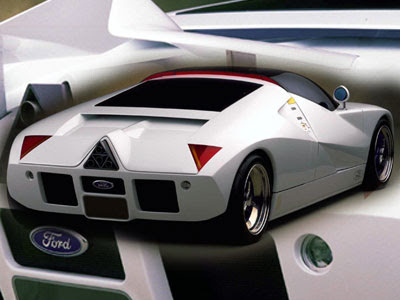
2010 Ford GT90 Super Sport Concept Car2010 Ford GT90 Super Sport Concept Car
The one-off GT90 Concept Car, labeled immediately as "the world's mightiest supercar" by Ford Motor Company on December 6, 1994, was the spiritual successor to the Ford GT40, the product of a colossal feud in the early 1960s between the Blue Oval from Dearborn and the Prancing Horse of Northern Italy. The GT90 draws from the design cues of its heritage and pays homage to the famed Le Mans-winning Ford GT40s of the 1960s, which were created after the failed attempt by Ford to buy out Ferrari.

At a development cost in the neighborhood of $3 million, the GT90 was certainly worthy of pulling styling cues from the original Ford GTs, and although it was never meant for production, it was built according to a Ford press release as a "test bed for technology, engineering and design concepts, and driver-oriented features that eventually may be used in Ford production vehicles."

Officially unveiled to the public in January 1995 at the Detroit Auto Show, the GT90 is finished in bright white with a bright blue and carbon fiber interior. It features a mid engine quad-turbocharged V12 that produces an estimated 720 horsepower and 660 pound-feet of torque. As a result, it had a claimed top speed of 253 mph, which even by today's standards would make it one of the fastest production cars in the world – faster even than a McLaren F1, which was widely considered the world's preeminent supercar at the time.
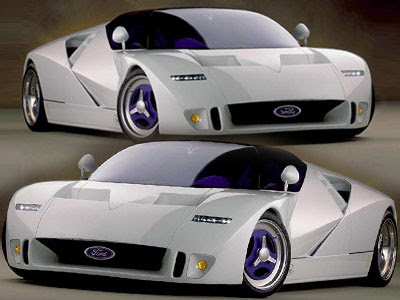
2010 Ford GT90 Super Sport Concept Car2010 Ford GT90 Super Sport Concept Car
The engine, which was a 48-valve six-liter V12, had to be combined together with four Garrett Systems T2 turbochargers in order to reach its estimated 720 horsepower and was based on the Ford Modular engine. Created by using parts of two Lincoln V8 engines, engineers removed the last pair of cylinders from the rear of one engine and the first pair of cylinders from the front of the other engine. The cut-down engines were then welded together with the final result being a 90-degree V12, which utilized a 90.2 mm bore and a 77.3 mm stroke to achieve maximum power.

The GT90 features the FFD-Ricardo five-speed manual gearbox found on the XJ220 and, considering the torque load that it is designed to handle, is noted as having a relatively light shift quality. Also borrowed from the XJ220 comes the all around double wishbone suspension that was designed to enable the car to handle well at top speeds.
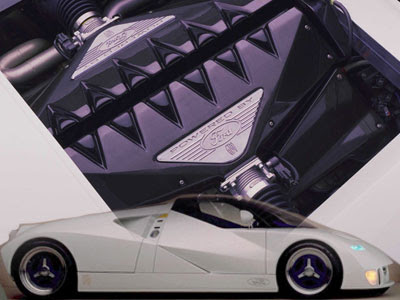
2010 Ford GT90 Super Sport Concept Car2010 Ford GT90 Super Sport Concept Car
Using Ford's new "Edge" design philosophy, the car incorporated advanced technology with a mixture of flat planes, angles, glass and triangular shapes that seemingly all collided together. The GT90 was the first car created using this new styling directive from Ford, which went on to be responsible for the creation of other Ford products like the Ka and Cougar. The effect is most impressive and a wonderfully executed stylistic throwback to its GT40 predecessor, which at once stays true to its heritage but acknowledges the advances in modern design. Taken directly from race car technology, the GT90 body panels are molded out of carbon fiber while the chassis is formed out of a honey-comb sectioned aluminum monocoque.

The GT90 is a test bed of advanced technology and design. It sports a tinted, laminated glass bubble over the cockpit and a spoiler that rises off the rear deck at high speeds. According to Ford, it has a "design that tightly enclosed its mechanicals with no wasted space; high tech lighting and blind-spot detection systems; and tiles like those on the space shuttle to shield the V12's exhaust outlets."
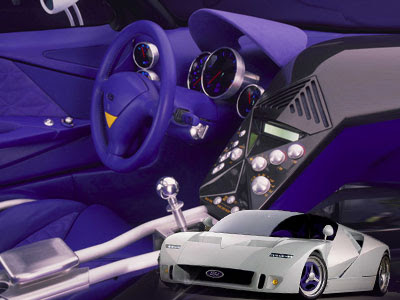
2010 Ford GT90 Super Sport Concept Car2010 Ford GT90 Super Sport Concept Car
After its unveiling in Detroit, the GT90 made its rounds on the Auto Show Circuit in 1995, traveling around the world to Frankfurt and as far away as Tokyo. With few other showings in between, the car recently was shipped over to Europe to be on display in the Ford of Europe 2008 exhibit at the Goodwood Festival of Speed. After returning home, the car was shipped to Alabama where it was on display as part of the Mustang 45th Anniversary Celebration.

This superb concept car remains in excellent running condition, having been properly stored and maintained over the years in between its show appearances. RM Auctions is proud to publicly offer the GT90 for the first time ever at auction. A remarkable one-off piece of automotive history and cutting-edge design, its offering may very well be a once in a lifetime opportunity for Ford devotees and concept car enthusiasts.

Tuesday, December 21, 2010

New Zealand Autocar and the National Business Review voted Mondeo MK3


The high-end features included in the vehicle are:

• Side Impact Bars
• Seat belt Pretensioners
• High model ABS
• Adaptive damping
• Self leveling suspension
• Traction Control
• Heated Front windscreen
• Electric sunroof
• Trip computers
• CD changer
• Alloy wheels
• Central locking system with remote
• Power windows
• Flat folding rear seats

The vehicle was marketed in several countries through out the world. The word Mondeo is derived from the Latin name meaning “World”. Ford released two of its vehicles namely the Mondeo MK1 and the Mondeo MK2. The Mondeo MK1 was released in the year 1993 and continued its production till 1996. This was released as a predecessor to the Ford Sierra. The Ford Mondeo was sold under the name of Ford Contour in the North America. The Mondeo family car released in the year 1995 in the country of Australia, but was not successful in terms of sales of the vehicle, due to the existence of dominating Falcon model in the country.

The Mondeo was launched as a predecessor to the Ford Sierra, Ford Royale, Ford Versailles and Ford Telstar models. The vehicle has its assembly plant at the Genk, Limburg, Belgium. The vehicle is available in both the diesel and the petrol engines. The available engines in the petrol are 3.0 L Duratech V6, 1.6 L Zetec I4, 2.5 L Duratech V6, 1.8 L Zetec I4, 2.0 L Duratech I4 and the 1.8 L Duratech I4, where as in the diesel type, the available engines are 1.8 L Endura- D turbo diesel I4, 2.2 L Duratorq turbo diesel I4 and the 2.0 L Duratorq turbo diesel I4 engines. The family car Nitro is related to the models like Jaguar X- Type, Ford Fusion and the Ford or Mercury Cougar.

The New Zealand Autocar and the National Business Review voted Mondeo MK3 as the car of the year in the year 2001. The model was released in the year 1997 in the South Africa as a replacement to the Ford Telstar, which was produced based on the Mazda. Ford released in the countries of Europe in the year 1998 was a coupe model, which was built based on the MK2 Mondeo and the Ford Cougar.

Ford Mondeo has won several awards ever since the beginning of its release namely the Car of the Year in the year 1993, European car of the Year in the year 1994, Top Gear car of the year in the year 2001, best used family car in the year 2006 and the Best Estate car in the year 2008 among the several other awards.

Sunday, December 19, 2010

Consider the New Ford Folcon Cars Details

Having spent the best part of the last two days with Toyota’s new Camry Hybrid, a car Toyota claims is its most important model in 50 years, it should come as no surprise that this car is every bit as good to drive as its regular petrol-powered sibling, and in some ways, even better.
Toyota Australia senior executive director, Mr David Buttner, says the new Camry Hybrid will “totally redefine Toyota”, and after driving a route spanning everything from inner-city gridlock, to fast-flowing freeways and even winding back-country lanes, it’s pretty clear that Australia’s first locally built hybrid car is well on track to becoming a serious success story for the brand – with both fleet and retail buyers alike certain to flock to Camry’s new flagship model.
The new Toyota Camry Hybrid is also just as good for Australian jobs as it is for Australian motorists with the local build, at Toyota’s Altona, Victoria complex, making Australia one of only four locations around the world to produce Hybrid vehicles – a clear sign of the manufacturer’s on-going commitment to producing locally built cars.
The decision to commit to a local build also increases the potential of more Australian-built hybrid models in the future, though at this point any decision on model type is speculative (though a RAV4 model was hinted at), and increases Avalon’s export opportunities, of which there are already a considerable few. At this point Toyota’s Hybrid Synergy Drive system is imported from Japan, though production may begin here if volume allows. The same goes for recycling of the battery pack at the end of its usable life.
From sign-off to production, the process of delivering the first Camry Hybrid has only taken six short months – an impressive feat for any manufacturer, and while based to a fair degree on its American Camry Hybrid Sportivo counterpart, Australian built Camry Hybrid models benefit from significant alterations to both the suspension and steering settings, a move necessary to appease Australian drivers’ need for better road feel and handling dynamics.
Following more than 10,000 kilometres of local testing, Toyota Australia’s engineers modified Camry Hybrid’s suspension calibration to uniquely suit local market demands – and harsh, varied Australian road conditions.
The long-travel, all-coil, fully independent suspension arrangement (MacPherson Strut – front / Dual-link Strut – rear) saw revised spring and damper rates all-round, changes to the rubber stiffness of the front upper suspension support and an altered front stabiliser.
The changes have made Camry Hybrid 8.5 per cent stiffer up front and 12.5 per cent stiffer in the rear, as compared to the petrol-powered model, but softer in its front stabiliser bar (by around 5 per cent) to reduce understeer, making the car more agile when cornering.
As with any hybrid model additional weight is an inescapable factor, though in Camry Hybrid’s case, the additional mass amounts to only 115 kilograms. Two electric motors (encased with the car’s CVT transmission) and a large, boot-mounted battery pack account for the added fat, but ironically this weight has actually improved Camry’s balance with the 59 kilogram battery pack (mounted in the boot between the rear wheels – see above) endowing Camry Hybrid with a near 50:50 front-to-rear weight distribution.
The boot offers 389-litres of cargo space, (or four standard sized golf bags in the traditional Japanese measure), a full-size spare wheel and 60:40 split fold rear seats – though a lot of the through space has been compromised by the battery pack.
On the road, the change in Camry’s balance is immediately evident from the petrol-powered model. An aftward shift of nearly 10 per cent in the car’s weight distribution makes Camry Hybrid more centered, less inclined to understeer, and not as front-heavy upon turn-in.
Interestingly the ride seems just as pliant as the regular Camry model being both controlled over lumps and bumps and well-settled on the choppy ‘C’ roads of Victoria’s panoramic Mornington Peninsula.The cabin is comfortably suspended and also suitably quiet. An acoustic deadening windscreen plus additional sound insulation between the engine bay and cabin helping in the cause.
At the traffic lights, when the stop-start function switches off the petrol engine, Camry Hybrid is silent, almost eerie, but very serene. It’s a relaxing experience, and quite enjoyable, once, that is, you get over the “stalled” sensation that occurs. Upon taking off from rest the car uses electric power until more motivation is needed, at which point the petrol motor seamlessly jumps to life for that added push.
The handsome, back-lit Optitron instrument panel is a stand-out feature in the otherwise standard Camry interior and, as well as looking the part, also offers a variety of fuel saving notifications including a litres per 100km dial (in lieu of a rev-counter),  a traditional trip computer with eco-driving graph and novel blue-rings around the dials that glow more intense the more economically you drive. During my return trip from Flinders yesterday afternoon these were quite vivid as I managed a 5.3L/100km average upon my arrival at Port Melbourne.
The upper-spec Camry Hybrid Luxury models also features a Prius-style read out on the centre satellite navigation/audio screen, further detailing multi-info economy graphs and energy flow display.
Camry Hybrid’s cabin is otherwise much the same as any other in the range, and for that reason makes the car no more challenging to drive than a regular model. The only significant difference to the controls being a ‘B’ (or Braking) mode on the gearshift selector that activates a stronger braking sensation when decelerating – similar to selecting a lower gear in a standard automatic transmission.
The electronic power steering (EPS) also offers an improved feel and draws less energy than traditional hydraulic units with a solid on-centre feel that becomes continuously progressive the further off-centre you turn. It’s a refreshing change for an electronic system to offer this level of feedback while still being light at car park speeds.
When it comes to the all-important question of what’s under the bonnet, Camry Hybrid utilises an Atkinson-cycle 2.4-litre four-cylinder engine – an evolution of its 2AZ-FXE engine – featuring double overhead camshaft and variable valve-timing, in conjunction with two electric motors (only one of which is used to propel the car).
The 16-valve petrol unit, which coincidentally runs on 91RON unleaded petrol, develops 110kW at 6,000rpm and 187Nm of torque at 4,400rpm while the electric motor adds 105kW (and 270Nm) for a combined system power rating of 140kW, or just one kilowatt less than the V6 engine that powered the previous generation six-cylinder Camry. The electric motor also acts as a generator while coasting to provide charge to both the 244.8-volt hybrid battery and 12-volt regular battery, also mounted in the boot.
These changes now mean Camry Hybrid takes the honour of being the most powerful and most efficient model in the current Camry range.
Power is delivered to the front wheels via a continuously variable transmission (CVT) to ensure smooth and strong acceleration with no compromise in performance or fuel economy. The electronically controlled transmission utilises planetary gears in place of belts or pulleys to ensure greater longevity and nearly imperceptible shifts in ratio.
The Camry Hybrid boasts a 0-100km/h time of just 8.9 seconds and a combined average fuel economy figure of just 6.0L/100km. Both electric motors and the CVT fit into the one compact casing.
Low CO2 emissions (Euro IV standard) of just 142g/km are further aided by other technologies throughout Camry Hybrid’s powertrain that include a single drivebelt on the engine (powering only the water pump), kinetic energy recovery and stop-start technology.
Other ancillaries such as the power steering pump and air-conditioning compressor are of electric operation to reduce strain on the engine while the alternator and starter motor are non-existent, replaced instead by a smaller electric motor cum generator that provides electrical charge, petrol engine starting and, peculiarly, the car’s reverse “gear”.
Camry Hybrid’s kinetic braking system and throttle are also electrically operated.
On the styling front, the Camry Hybrid is rather understated with most of the changes made more about function than form.
A revised front fascia with smaller grille and larger lower air intake allow additional cooling for the altered under-bonnet air flow requirements needed by the hybrid system. Flatter sides at the front corners of the bumper allow smoother air flow down the car’s profile, while underneath, diffusers beneath the engine compartment, rear floor assembly and fuel tank help Camry Hybrid carve a more slippery path through the air.

Thursday, November 18, 2010

Ford Cars 2011 Models

ford 2011 photo
The new Ford Explorer with an available EcoBoost2.0-liter I-4. Combining direct injection of gasoline and turbocharging, this advanced engine delivers performance comparable to normally aspirated competitive V6 engines. Developing up to 237 horsepower at 5,500 rpm, this I-4 delivers 250 lb.-ft. of torque.Estimated fuel economy improves by more than 30 percent, putting the fuel efficiency of the Ford Explorer in line with sedans such as the 2010 Toyota Camry V6.Like other Ford EcoBoost engines, peak torque is generated at a low 1,700 rpm across a broad band to 4,000 rpm. This torque plateau makes for flexible, efficient power delivery across a wide range of engine and vehicle speeds, while helping save fuel by making power at lower rpm levels. Ti-VCT, four valves per cylinder and DAMB valve lifters increase mechanical efficiency through improved engine breathing across the broad power and torque bands.A relatively high compression ratio is enabled by the use of direct gasoline injection, operating at fuel pressures from 2,200 to 2,800 psi. The unique turbocharger is optimally matched to the EcoBoost I-4 engine and SUV vehicle performance behavior. Precise fuel pressure control allows the Ford Explorer I-4 to deliver boosted power at low rpm, without annoying turbo lag.The EcoBoost I-4 uses 5W30-GF4 oil to reduce friction and reduce cost of ownership through 10,000-mile oil change intervals
Ford Car F-150 Photo
Ford, the definitive leader in tough trucks, is further building on its solid foundation of the new F-150 to deliver the all-new 2010 Ford F-150 SVT Raptor, a purpose-built, high-performance off-road truck that's versatile enough to take on the most challenging desert adventures, as well as the everyday commute.

“Ford trucks have been a mainstay on the off-road racing scene for more that 20 years because of our long history of capability and durability,” said Derrick Kuzak, Ford's group vice president for Global Product Development. “With the F-150 SVT Raptor, we will be delivering a true off-road performance truck with the proven 'Built Ford Tough' capability and durability that is at the core of every F-150.”

Ford and off-road racing

Desert off-road racing is something Ford knows and does well, with eight championships in nine divisions in the 2007 “Best In The Desert” series and four more titles in CORR (Championship Off Road Racing). Ford has also shown its leadership at the Baja 1000 race - 12 Ford-powered vehicles have won the overall title for four-wheel vehicles, the most of any engine manufacturer.

With interest in off-road performance growing steadily, the F-150 SVT Raptor was designed to fulfill the desires of that highly demanding market. The high-performance off-road truck market is one that's largely untapped, allowing the Ford F-150 SVT Raptor to set the bar for this type of vehicle.

“Most of the major manufacturers have focused on on-road performance, so when we looked at what was available in off-road truck performance, it was somewhat limited,” said Mark Grueber, Ford product marketing manager for pickups and large SUVs. “This was the perfect opportunity for Ford to further differentiate the F-150 from other trucks on the market.”

Looks tough and fast

The tough, chiseled look of the new Ford F-150 has been taken to a new level with F-150 SVT Raptor. The agile performance truck was designed to give the impression that it's always on the move.

Noticeable differences between the Ford F-150 SVT Raptor and the conventional F-150 will include a distinctive grille that has the Ford name carved into it; front bumper, vented hood, front fascia and fenders, functional hood extractors, fender extractors with “SVT” bored out, as well as visible Fox Racing Shox.

Another key difference between the F-150 SVT Raptor and the base F-150 is that it is more than seven inches wider. Ford designers took advantage of this difference and highlighted it with distinctive marker lamps. When turned off, the marker lamps are well integrated into the F-150 SVT Raptor's front end, as opposed to on top of the cab. When lit up, Raptor's imposing stance is immediately recognizable.

While the exterior design of the F-150 SVT Raptor is about creating an image, the interior design is about creating the feel of the truck, and both must complement each other.

Design elements from the unique grille and front fascia have been carried through to the interior on the console and dashboard. The steering wheel is wrapped in black leather and features a molten-orange leather strip that serves as a centering sight line - which is especially useful in extreme driving maneuvers that can often cause the driver to lose perspective of the steering wheel's center point.

Revved up and ready

The Ford F-150 SVT Raptor is powered by the F-150's proven 5.4-liter Triton® V8 three-valve engine, which delivers 320 horsepower and 390 lb.-ft. of torque. A new open-valve fuel-injection strategy improves the air/fuel charge conditions in the combustion chamber, allowing greater spark advance at higher loads and engine speeds.

A new 6.2-liter V8 engine will be available after launch. The 6.2-liter engine features all-new architecture specifically designed for robustness in a truck application. Given that reliability and longevity under harsh conditions are key to truck customers, the Ford team performed extensive testing to ensure the 6.2-liter V8 engine would live up to the “Built Ford Tough” promise.

Take off and landing
Building a high-performance off-road truck is not just about the horsepower - it's about the suspension. The F-150 SVT Raptor doesn't disappoint, with 13.4 inches of usable travel in the rear suspension and 11.2 in the front.

“With the F-150 SVT Raptor, we changed the axle, the whole front suspension is different - new upper A arm, new lower A arm, new tie rods, new half-shaft joints,” said Jamal Hameedi, Ford SVT chief engineer. “The suspension does all the work to keep the truck's attitude stable.”

In addition to a beefed-up suspension, the F-150 SVT Raptor also boasts unique internal-bypass Fox Racing Shox.

“This truck is also going to be a daily driver. We brought together a lot of experts to ensure the on-road steering precision and comfort was there too,” said Hameedi. “That's where Ford expertise really came to the table and complemented Fox's off-road expertise.”

Specialized Technologies
The F-150 SVT Raptor provides the complete package for off-roaders, including state-of-the-art technologies to keep it at the top of capability.

“For many years, enthusiasts have been struggling with the performance of electronic technologies in the extreme off-road environment since that was not the environment they were designed for,” Hameedi said. “What SVT has done is tailor technology to function in both an on-road and an extreme off-road environment.”

The F-150 SVT Raptor will be built alongside the new F-150 at Ford's Dearborn Truck Plant at the historic Rouge Center in Dearborn, Mich. It will be available in spring of 2009.

The Ford F-150 SVT Raptor R will take on Baja 1000

The Ford F-150 SVT Raptor R, which features modified components, was developed by SVT and Ford Racing specifically to race in the Tecate SCORE Baja 1000 - one of the most grueling off-road races on the circuit.

Prepared for racing in long-distance off-road endurance events, the Ford F-150 SVT Raptor R uses stock components of the F-150 SVT Raptor, including the transmission, brakes and axles. The frame - the part of the truck that will take the most stress - is the same proven fully boxed frame that delivers class-leading towing and hauling in the base F-150. The race truck is powered by a specially calibrated 500 horsepower, 6.2-liter V8 engine. Placing the Ford F-150 SVT Raptor R in the Baja 1000 also serves as a test bed for development of the production F-150 SVT Raptor.

Ford is bringing some of the best stock class off-road truck drivers together to drive the F-150 SVT Raptor R in the Baja 1000. The team includes driver of record Steve Oligos and co-drivers Randy Merritt, Greg Foutz and Bud Brutsman who will compete in class eight for moderately modified full-size pickup trucks.

The Baja 1000 will run Nov. 20-23. The intense off-road endurance race runs from sea level up to 7,000 feet over 1,000 kilometers of sand, rock and mountain passes on the Mexican Baja Peninsula.

Ford GT 2010


Ford GT Wallpaper
Ford GT Wallpaper
Ford GT Wallpaper

Wednesday, November 17, 2010

Ford Cars allpapers 2010

ford cars wallpapers


ford cars wallpapersford cars wallpapers
ford cars wallpapers

Ford Focus 2012

Together with their global siblings, Focus models rank as the 40th bestselling automotive nameplate worldwide, with over 5 million sold. While U.S. sales of the Focus peaked in 2000 at 286,000 vehicles, the Wall Street Journal reported in May, 2009 an estimate that the Ford Focus lost as much as $1 billion a year.

2012 Ford Focus

2012 Ford Focus
2012 Ford Focus

2012 Ford Focus
2012 Ford Focus

2012 Ford Focus
2012 Ford Focus


2012 Ford Focus
2012 Ford Focus

2012 Ford Focus
2012 Ford Focus

2012 Ford Focus
2012 Ford Focus

2012 Ford Focus
2012 Ford Focus

2012 Ford Focus
2012 Ford Focus

2012 Ford Focus

2012 Ford Focus 
2012 Ford Focus

Click Winks